A home staging report is a written, room-by-room plan that tells a seller exactly how to prepare their occupied home for sale: what to remove, what to move, what to keep, and what to restyle. It is the document a listing agent hands the seller after the walkthrough, and it is the difference between staging advice that gets nodded at and staging that gets done.
Most sellers never receive one. They get a walk through the house, a few comments about the couch and the family photos, and a promise that the photographer is coming Thursday. Then they stand in the living room on Wednesday night trying to remember what the agent said. A report fixes that. It puts the plan on paper, in order, with pictures.
What a home staging report contains
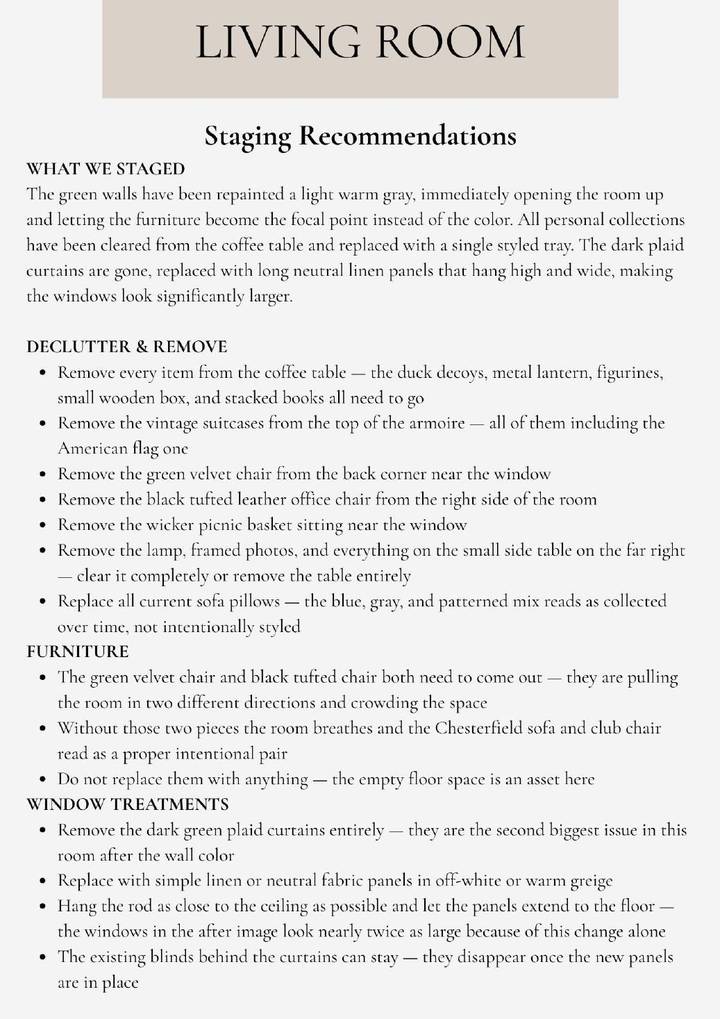
The format varies by who makes it, but a complete report has the same parts. A cover and a welcome page, which set the tone and, on a good report, carry the agent's name and contact details rather than a vendor's. A short section on staging principles the seller applies everywhere: edit first, depersonalize, style with intention. Then the heart of the document, room-by-room recommendations. Each room gets its own page naming specific pieces and specific actions: which chair leaves, which curtains get swapped for plain panels, what stays on the coffee table, what to do about the wall color if budget allows.
The best reports add two things most do not. A staged after image of the seller's actual room, showing the plan carried out with their own furniture, and a working checklist the seller can move through box by box. The image is what makes sellers believe the plan. The checklist is what makes them finish it.
What it is not
A staging report is not a photo edit. Virtual staging changes the listing photograph and leaves the real room alone, which works for a vacant house and creates a problem in an occupied one, because the buyer arrives expecting the photo. A staging report changes the real room. Nothing in the listing needs a disclosure, and the house at the showing matches the house online.
It is also not a design plan. A design plan makes a room nicer to live in. A staging report makes a room easier to sell, which often means removing things the seller loves and neutralizing choices that are perfectly good taste. The report says so plainly, and because it is written rather than said, the agent does not have to.
Who makes one, and what it costs
Traditionally, a professional stager. An occupied staging consultation runs a few hundred dollars, takes an hour or two in the home, and may or may not end in a written document. Many end in verbal advice and a follow-up email. That price and that turnaround are why reports have been reserved for higher-end listings and why most sellers have never seen one.
The newer route is a report generated from the photos the agent already takes at the listing appointment. The agent uploads one photo per room and receives the full document, with the room-by-room direction and the rendered after images, priced per report and ready the same day. That changes the question from "which listings deserve a staging plan" to "why would any listing go without one."
Stage My Space produces the complete Home Staging Report from room photos: the branded cover and welcome page, room-by-room recommendations, a checklist, and a staged after image of every room built around the seller's own furniture. Ready in minutes, delivered under the agent's name.
Stage Your First Room FreeWhat the seller should expect from it
A report should be specific enough to act on without a phone call. "Declutter the kitchen" is not a recommendation. "Clear the counters except the coffee maker, remove everything from the refrigerator door, and take the bar stools down to two" is. The test of every line is whether the seller could do it on a Saturday morning with the report in one hand.
It should also be honest about money. Most of the work in an occupied home is subtraction and costs nothing. Where a small purchase helps, the report should name it: neutral pillow covers, a tray for the coffee table, plain curtain panels. Where a bigger spend helps, like repainting a bold accent wall, it should say "if budget allows" and explain why.
Whose name is on it
The agent's. A report that arrives with the listing agent's logo on the cover and their headshot and contact details on the welcome page is received as part of the agent's service. The same document from an unfamiliar vendor is a stranger's opinion. This is not vanity. It changes whether the seller follows the plan, and it travels: sellers show these documents to friends who are thinking about listing, and the agent's name goes with it.
Frequently asked questions
Is a home staging report the same as a staging consultation?
A consultation is the visit. A report is the written plan that comes out of it. Many consultations end with verbal advice only. A report puts the plan on paper so the seller can work through it after the stager or agent has left.
How long does a home staging report take?
An in-person consultation with a written report usually takes a few days from the visit to delivery. A report generated from room photos through Stage My Space is ready in minutes.
Does the seller have to buy anything?
Most of a good report is editing: what to remove, what to move, what to keep. Some recommendations suggest small purchases such as pillow covers, a tray, or a throw. Large purchases are rare because the plan is built around the furniture the seller already owns.
Who gives the seller the report?
The listing agent. Reports made through Stage My Space carry the agent's logo, headshot, and contact details, so the seller receives it as part of their agent's service.